


CRF with grain maize at the Wambergen trials centre in 2025
Introduction
A grain maize trial with Controlled Row Farming (CRF) was set up at Gut Wambergen in the 2025 growing season. Various methods of chemical and chemical-mechanical weed control were tested. Other topics included the establishment of companion crops, yield and cost effectiveness. The objective of the trial was to evaluate the functionality of the methods used in CRF and to derive recommendations for action for practical operation. The previous catch crop in the the CRF V1 variant was a white clover, which had already been established as a companion crop in the preceding crop of winter wheat. The catch crop mixture TerraLife MaisPro 30 TR had been sown in the other variants (Amazone catch crop trial).
Sowing and trial site
The grain maize was sown on 25/04/2025 with a 6 m Precea 6000-2FCC and an FTender 2200 for under-root fertilisation. The variety DSV Rafting was sown at a rate of 9 seeds/m². In this respect, the CRF variants were sown with a 50cm row width and the conventional variant on a 75cm row width.
At the beginning of June, the companion crop was sown with a Greendrill mounted on the hoeing machine. The Zea Pro blend was used in the CRF V1 variant and the Soil Protect blend in CRF V3. The companion crops should help suppress weeds, provide shade for the soil surface and enable more stable nutrient dynamics.
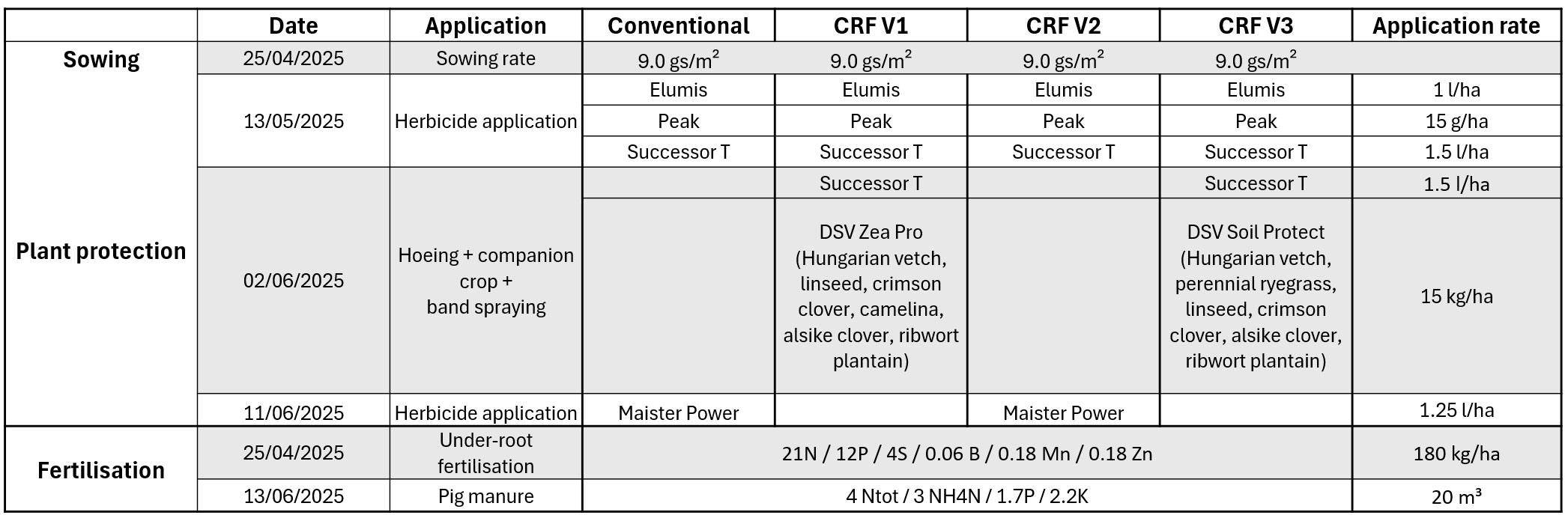
The slurry was spread on the existing maize crop in BBCH 16 on 11/06/2025. The maize germinated evenly in all variants without any major problems.
The grain maize was harvested with a Claas Trion and a picker from the manufacturer Capello. The row width of the picker was 75cm.
Crop development and weed control
The mechanical weed control was carried out with a hoe and supplemented by integrated band spraying with an FT-P1500. The weed suppression was very good in all variants, whereby the combination of band application and hoe had the same effect as the full-area herbicide application. The band application enabled the amount of herbicide to be reduced by 50%. In the hoeing variants, residual plants were observed to ripen later, which is presumably due to greater mineralisation caused by soil movement.
The companion crop only had a limited impact on crop development due to the difficult establishment conditions. The subsequent spreading of liquid manure with an absence of rainfall meant that the companion crops were unable to establish themselves.
Yields
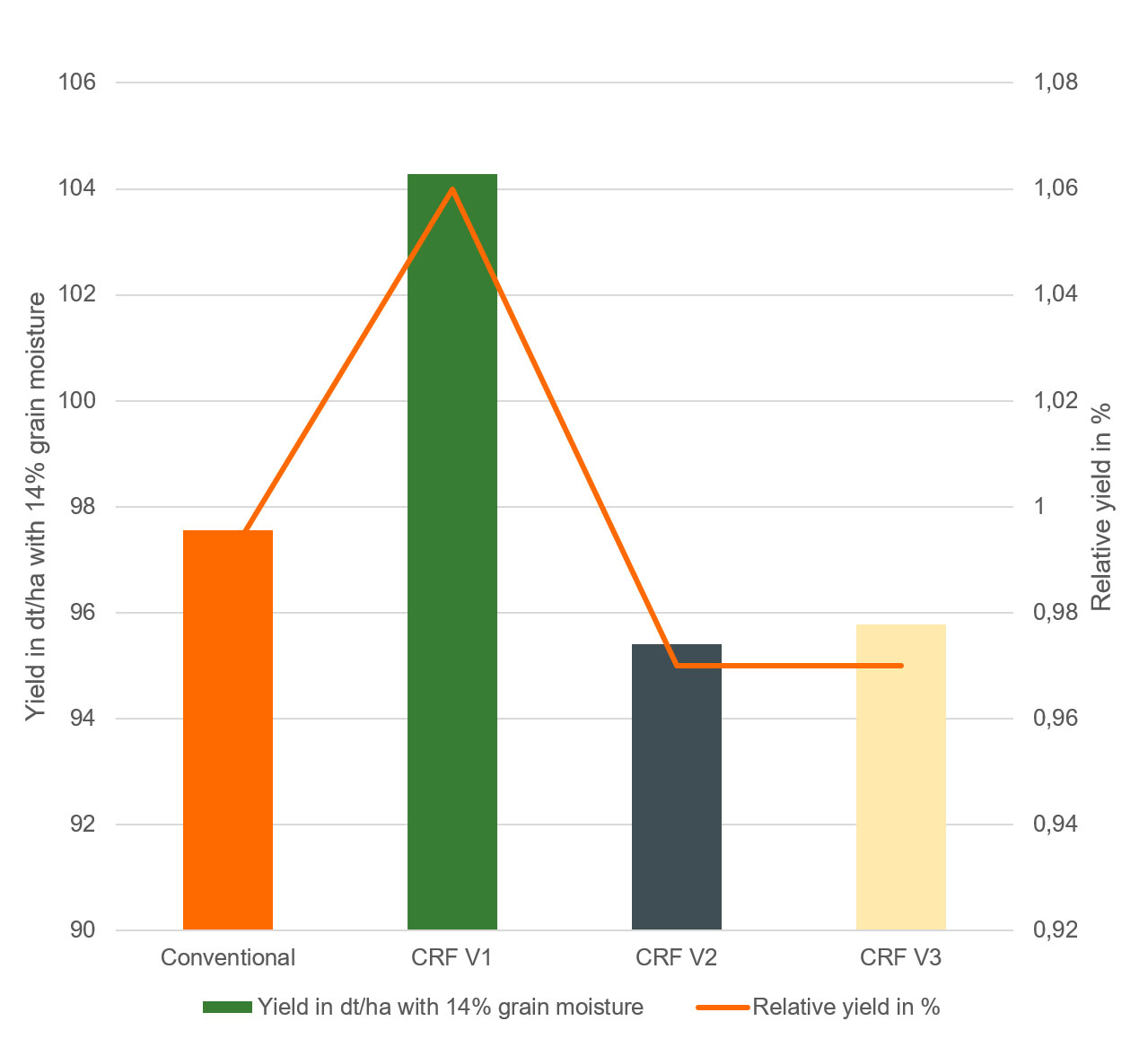
The yield measurements showed differences between the methods. The CRF V1 variant produced the highest yield of 104.8 dt/ha with 14 % grain moisture. In this case, the intense soil tillage, the hoeing passes and the good preceding crop effect of the white clover catch crop had a positive effect on the nutrient availability and therefore on the development of the maize.
The CRF V2 and CRF V3 variants were below the yield of the conventional method. In addition to the lack of companion crop development, higher harvest losses also influenced the results. Additional losses of 2–3 % were incurred as a result of the 50 cm row width of the maize and the use of a maize picker designed for 75 cm. These were directly reflected in the yield.
Efficiency
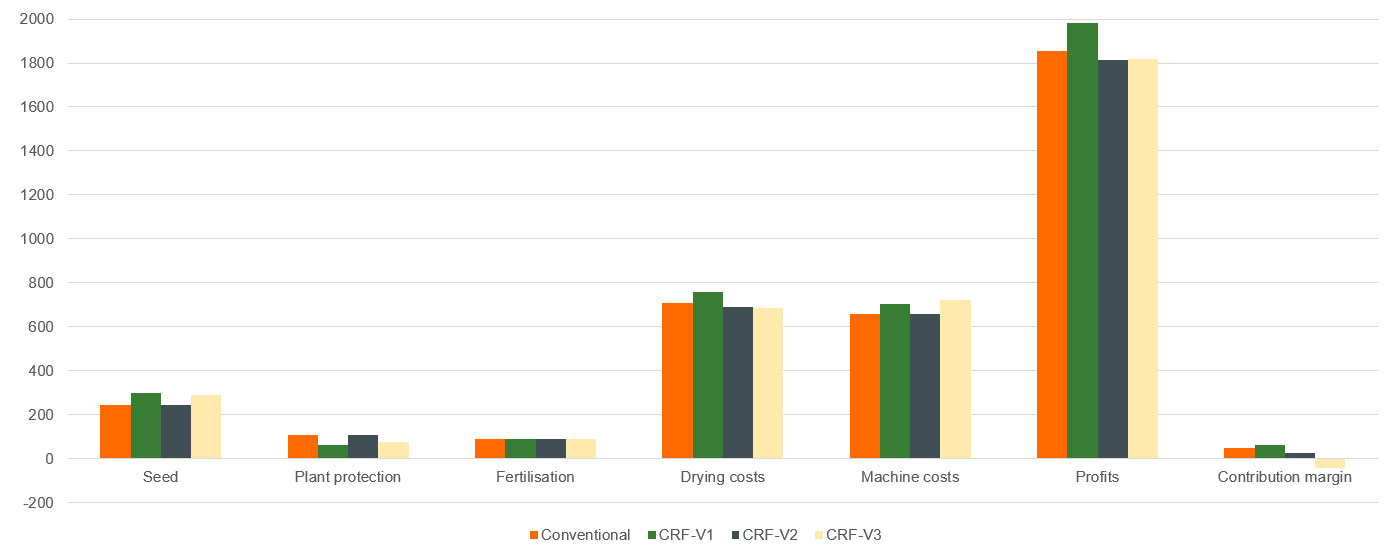
As a result of a low producer price of 19 €/dt, the contribution margins were generally modest.
- CRF V1 generated the highest contribution margin with 64 €/ha.
- CRF V3 was the lowest with –41 €/ha.
The mechanical weed control resulted in lower plant protection costs. However, this was offset by higher seed costs for the companion crops as well as more expensive hoeing work. The drying costs varied depending on the generated yields.
Conclusion
The trial shows that CRF is fundamentally viable in grain maize production and that it is possible to reduce the use of plant protection agents. The combination of band spraying and mechanical hoeing suppressed weeds at the level of a full-area herbicide strategy. However, reliable establishment of the companion crops is critical for the continued success of the system. The sowing date and liquid manure management must be further optimised here.
The differences in yield between the methods show that CRF can achieve yield advantages under favourable conditions, as was evident in CRF V1. The results also show that technical aspects, such as the compatibility of row widths and harvesting technology, make a decisive contribution to the productive capacity of the system.
