


Trial report on winter barley – wide rows and better N fertiliser efficiency
Controlled Row Farming (CRF) aims to make more precise use of inputs, conserve resources and, at the same time, maintain the yield potential in cereal crops. A key component of this system is what is known as the "wide row": lower seed rates, wider row spacing and the ability to apply fertiliser and pesticides directly to the crop row.
A trial, which was studied in detail as part of a thesis at the Osnabrück University of Applied Sciences, investigated the effect of row-specific nitrogen fertilisation on the development of barley crops.
Less seed, same yields
Two differing establishment systems were compared in the trial:
- Normal establishment with a row spacing of 12.5 cm and full-width N fertilisation
- Wide row with a row spacing of 37.5 cm, half the seed rate and row-specific nitrogen application via the Y-Drop method.
The two systems were also trialled at three levels of nitrogen: 100 %, 80 % and 50 % of the permissible N-quantity. In this respect, the seed rate of 165 germination capable seeds per square metre in the "wide row" system was only half the rate of 330 seeds per square metre in the normal establishment system.
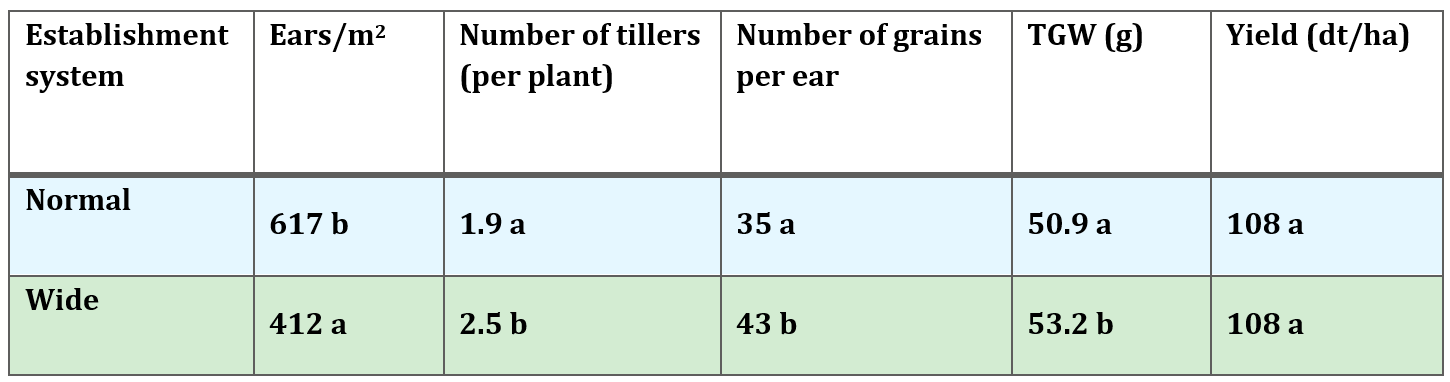
The winter barley produced an almost identical plant count from both systems despite this significant reduction in the seed rate. An average yield of around 108 dt/ha was obtained from both the normal establishment and in the wide row.
The individual plant makes the difference
The lower crop density was compensated for by increased tillering, more grains per ear and higher thousand grain weights. This resulted in a significant increase in the output of the individual plants.
Row-specific fertilisation with Y-Drop
An Amazone UF 1302 with a prototype Y-Drop drag hose system was used for the row-specific nitrogen application. The liquid fertiliser was applied directly along the plant row.
More raw protein despite the lower crop density
In addition to the yield, the grain quality also played an important role. An advantage of the wide row became apparent here: the raw protein content of the winter barley was significantly higher than in the normal establishment.
The reason lies in the improved supply of light, water and nutrients to each individual plant. The reduced competition within the crop enabled a more efficient uptake of nitrogen in the grain. This result is consistent with a large number of studies from the field of organic and conventional cereal establishment, in which a wider row spacing was frequently associated with a higher raw protein content.
Summary
The results show the potential of the CRF system. Comparable yields were obtained in spite of a 50 % reduction in the seed rate. At the same time, the system opens up new possibilities for precision agriculture, mechanical weed control and the integration of undersown crops.
